Are you putting the most important things first?
Most of us are bad about recognizing what ARE the most important things. Have you heard of the Pareto Principle? You may have heard of it as the 80/20 rule. Simply said, out of ten projects on your plate, 20% of your activity will result in 80% outcome. So we want to make sure we are putting first things first. One of the ways we do this best is by making sure our schedules reflect what is important in our lives.
Scheduling is just another word for planning that is more detailed.
Tweet
Spinning our wheels
Have you known some people who talk about how busy they were on any one day? They really haven’t accomplished much for all their efforts. I know many people, men and women, who spin their wheels because they waste time on activities that don’t really produce big results. Recently, I talked with someone who says she is fairly compulsive and likes her home and surroundings neat and organized. And that’s not true by anyone’s standards. Seriously.
Oh, that we would really see ourselves. Right?
These people are like hamsters on a wheel. They never really get anywhere. And the crazy thing? They get up the next day and do it all over again.
Schedules lead to routines
A schedule is merely a step to establishing a routine. Once we have that routine in place, the schedule takes a back seat. It’s:
But I know other people who can get more done in a concentrated period of time than most people, and you will never see these people rushing around because they are focused on the end result. They put 80% of their effort into that top 20% into the most important. I know three of these people personally: my husband, my daughter, and my son. What they can get done in a concentrated amount of time is amazing. It seems to take no effort. While I get as much done as they do, but I’m running faster!
So it goes like this when creating your schedule:
determine what is important,
create a schedule that takes that reflects your values
live the schedule until it becomes routine.
What’s important to you?
As a Christian, there is one single task that should take precedence over all the others: prayer and Bible study. Years ago, my husband and I felt we needed to revamp our time-with-God schedule. I hate to admit it, but we had been in the habit of getting our coffee, watching the news for maybe 30 minutes, and then having our devotions. While prayer and Bible study had always been a priority for us, it wasn’t the very first thing we did. Now it is. We’re putting the important thing first.
We do this in this order:
- get up before 7:00
- make the bed
- get dressed, and then we each
- go to our preferred spaces in the house for personal prayer and Bible study. After that, we
- come together to read a devotional out loud, and then one of us prays. My husband prays on M, W, and F, and I pray on Tues, Thurs, and Sat.
I can truly say putting 80% of our effort into what only takes 20% of our day has made all the difference.
January: natural time to reexamine the important
But the thing is, you have to know where you’re wasting time or spinning your wheels, right? That’s why I love January. It’s a great time to examine everything we do. For example, how often do you repeat a task or even a motion that is unnecessary and doesn’t get you closer to your goal? Does the carpet really need vacuuming every day? Or does your work desk have to be spotless all the time?
Sometimes, I’ve found that if I manage some of these tasks on a continual basis, I never really get behind, anyway. For example, I tidy and wipe down sinks daily. This is one of those repetitive tasks that actually does make sense. It only takes minutes, and it prevents hours of cleaning.
But remember:
But remember, having a schedule doesn’t mean you are so severely regimented that you never have time to be spontaneous. Quite the contrary, it means you are organized and getting things done on a regular basis so you can play. We can even schedule free time.
I’m going to create a daily schedule for each day of the week so that I can plan leisure time. That way, it will serve as a reward for meeting goals. Remember, I’m analyzing my routines and habits, so this all works together.
See yourself in a movie.
If you can do this, it really helps. Watch yourself for one day and try to track how you spend your time. Are you repeating tasks that don’t need repeating? Are your actions consistent with your goals? Do you find yourself repeating a task that could have been taken care of once? For example, we have an unspoken rule: no one goes upstairs or downstairs empty-handed. There’s almost always something that needs to be taken up or down.
Schedule your perfect day, putting the most important first
This is a great practice. I did it for the first time this week myself. I’d read about it often but had actually never tried it. Here’s the download of what I think my perfect day would be, what I think it really looks like, and a blank copy for you to fill in. I overestimated I can do in one day. It truly would have to be the perfect day.
Now, you may ask, “Why is a schedule so important? That sounds awful, Rebecca. That sounds way too regimented for me!” There’s a reason.
The importance of scheduling
First, I want to give God as much time as he needs to accomplish his purpose in my life. I don’t want to leave wasted time on the table of eternity. I can’t do that if I’m abusing the days I have left. Psalm 90 reminds us our days are numbered. We don’t like to hear that. No one does. But it’s true, and we need to use our time in a way that makes the best use of our time and energy so we can be effective for God. I want to have time for my husband, family, and friends. I want time to pursue my other interests. That means a schedule.
But we can’t do it all.
So, when I created my schedule, I thought. Gosh, I’m exhausted just looking at it. But then I realized, I can’t possibly do it all. No one can. There will always be something undone. And we have to learn how to be comfortable with that: I, especially, have to work on that.
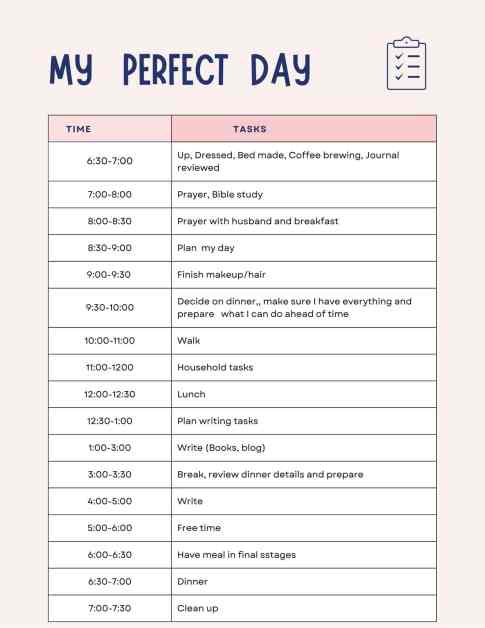
I have my morning schedule down pat, and I rarely alter it unless I can’t avoid it. And obviously, that happens. I’m OK with that, especially if it’s because of family and friends, but I try to avoid scheduling appointments during those hours.
You can tell by looking at my ideal day it doesn’t allow for getting up late, interruptions (aren’t there always?), the unexpected, and so on. But it’s a place to start. It’s good to have a plan even when you know you can’t always follow up. (By the way, my actual schedule for the next day was way off because I got up late.
So, here’s a template for you if you want to print it out and give it a shot.
Schedules free us
Scheduling our days actually frees us. If we can look at our day and keep ourselves on track, we will have more time to devote to the truly important. There is no way I could write as much as I do were I not to follow a schedule. And that’s my mission, my calling, my purpose. It helps, of course, that I know this. And if you don’t, my book “More” (e-book and soft cover) will help.
Schedules should be freeing but not restricting.
God’s word encourages planning.
If you wonder what God’s word says about planning, read the book of Proverbs. Read the directions God gives various leaders in the Bible about planning. One of my favorites is Luke 14:28.

Suppose one of you wants to build a tower. Won’t you first sit down and estimate the cost to see if you have enough money to complete it?
Luke 14:28
But when we create our schedule, it should always be in light of living out God’s purpose. It’s not our schedule; it’s OUR (ours and God’s) schedule. We create it in light of what we believe is our purpose.
Give it a try, and let me know if you think your day works better when you have a schedule. I purposely got very specific with the time slots, but you certainly don’t have to. When I create the final schedule, I will plan in bigger chunks.
What do you think? Think you might want to try it?
Anyway, that’s it for today.
I hope you have a wonderful rest of your week and blessings to each of you.
- Happy Friday! Embrace yourself for the unique person you are.

- Why Discretion and Understanding Are Essential To Guard Your Heart

- So what am I up to this week?

PS: I haven’t mentioned the fire in Los Angeles, but they’ve certainly been the focus of our prayers since last week. When this is finally over, let’s not forget them. And let’s not forget those in North Carolina. It takes a long time to start over when you’ve lost everything. The news will move on, but the needs will remain.
